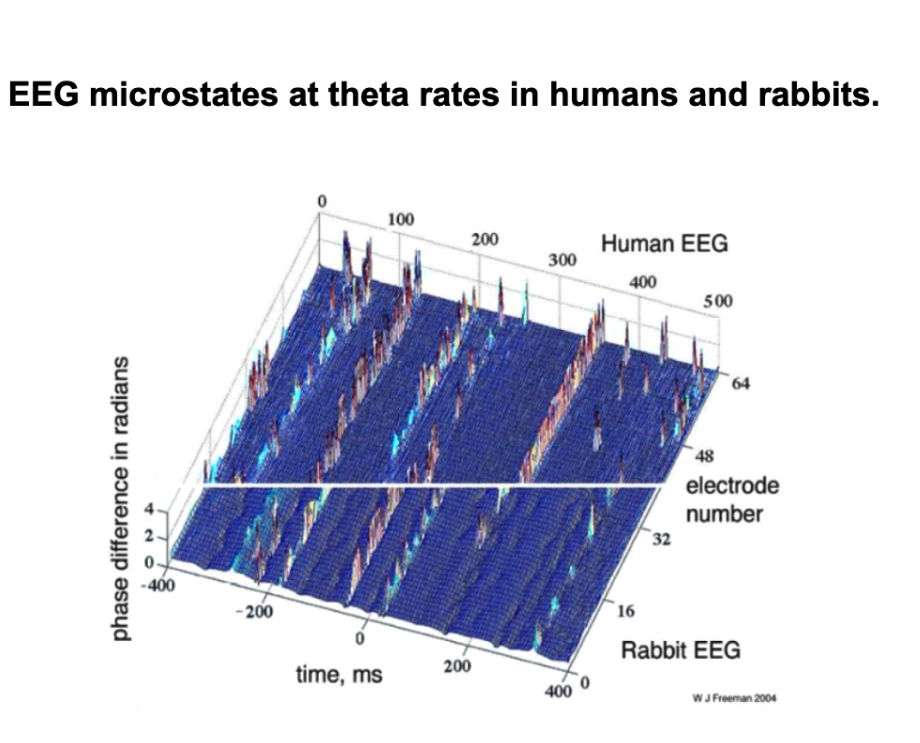
For over a hundred years, since Hans Berger recorded the first human EEG in 1924, we’ve described the brain’s electrical activity the same way: oscillations, frequencies over time, a kind of continuous hum. Turns out this picture is incomplete, and the correction might be one of the most striking findings in this whole field.
In this seminar, Robert Kozma, a mathematician, former nuclear physicist, and longtime collaborator of the late Walter J. Freeman, cognitive scientist Joshua Davis, and psychobiologist Bernard Baars work through a stunning discovery about how the cortex works.
When you apply the right kind of analysis to brain recordings—Hilbert analysis, a bit of Fourier transformation—the smooth hum disappears, and something else appears in its place: a click. Roughly ~90 milliseconds of stable, self-organized order, followed by a sudden 5-to-10-millisecond chaotic collapse, then order again. A shutter, opening and closing, over and over.
This exact rhythm shows up in both rabbit cortex and human cortex, clicking at close to the same rate.
Biology rarely hands you that kind of agreement across species this different.