
Develop Expertise In
Psychology, Neuroscience, Biology

Shareable Certificate
Add to LinkedIn profile or resume

English
Transcript & Downloadable PDFs
Psychology, Neuroscience, Biology
Add to LinkedIn profile or resume
Transcript & Downloadable PDFs
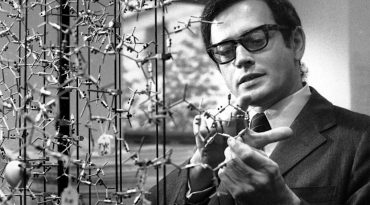
The common thread running through scientific pursuits of David Edelman’s father, Nobel Laureate Gerald Edelman, was an enduring interest in the relationship between biology and experience. Neuronal Group Selection, or Neural Darwinism, is the culmination of his efforts to reconcile the two.
"Our journeys into the nature of consciousness serve as a tribute to my Dad, Nobel Laureate Gerald Edelman, to his verdant imagination, immense creativity, prodigious output, and the many discussions about the scientific study of consciousness and biological science generally that were shared within these four walls."
Consciousness may seem simple and obvious to many of us. When we’re awake, we are aware of the outer world and of our own inner thoughts and feelings. When we fall asleep, inner and outer awareness slips away.
It is thought that there must be a time when the emerging brain changes from a small, non-conscious collection of neurons to a massive, 86 billion-cell structure enabling conscious feelings, sensory perception and thoughts. When is that time of transition? When do the first useful memories form?
Video 13 Min + 7 Min read to complete + Quiz
What is it about a particular animal’s makeup ⎯ its nervous system, its senses, its behavior, its social interactions ⎯ that indicates that it is truly conscious?
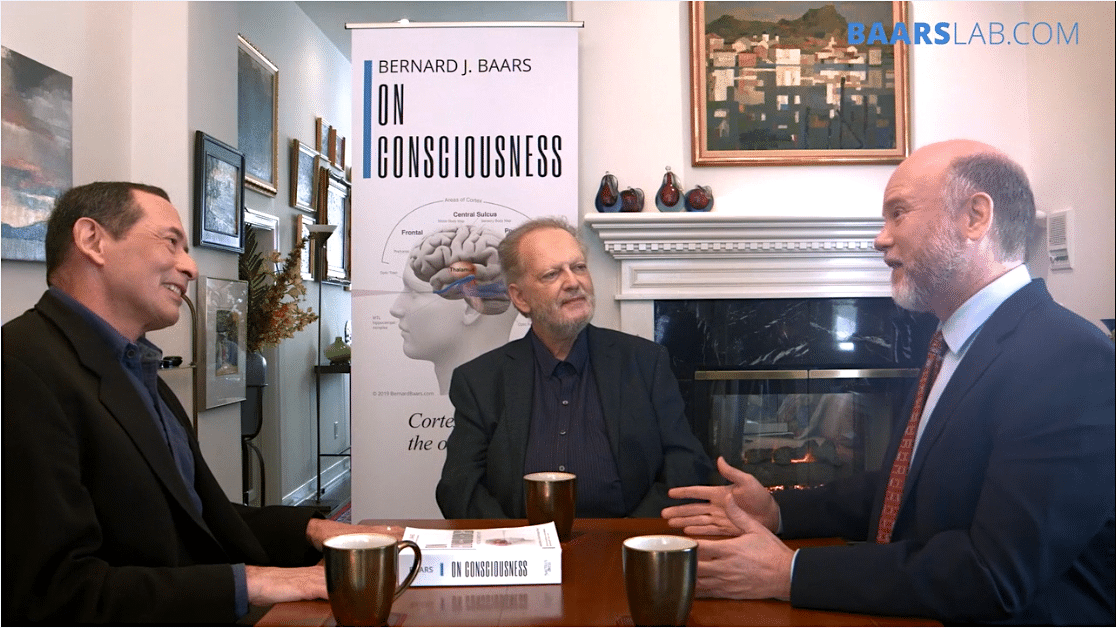
Baars, Edelman and Giedd explore main aspects of consciousness from varying perspectives and with an evolutionary lens in a thought-provoking discussion. We start with the simplest of observational definitions that lay out the logic of scientific discovery. Science has to be open to surprising new ideas, but we can start with what we can test.
Video 39 Min + 14 Min reads to complete + Quiz
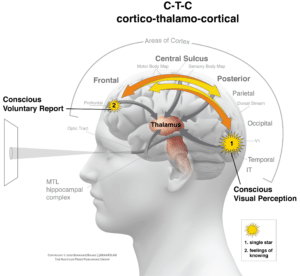
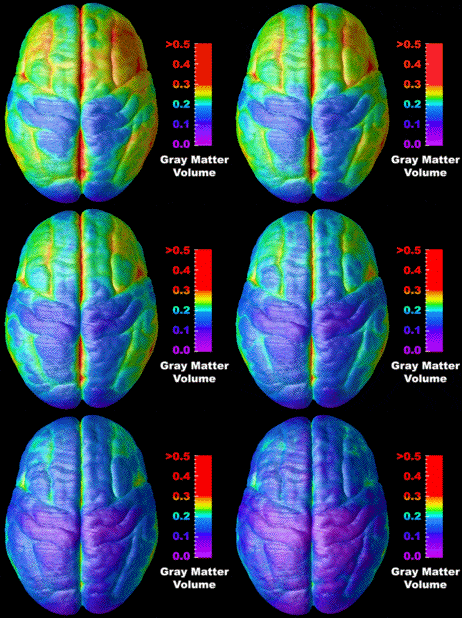 How does consciousness come together in the brain? How does memory figure into consciousness?
Knowing how we acquire coherent perceptual insights about the world and then commit those insights to memory, can we tune the learning process to optimize the acquisition of new skills? And when do humans and some non-human animals cross this rubicon of awareness?
Video 21 Min + 16 Min reads to complete + Quiz
Video 21 Min + 18 Min reads to complete + Quiz