
Reflecting on Consciousness as a Biological Phenomenon.
The species in which we have the most confidence is humans, and therefore humans are our “model species” by which we can plausibly judge other species.
There are no hominids left besides Homo sapiens, but there are strong analogues for the visual cortex in the rhesus macaque, for example. The macaque cortex has been extensively studied for that reason.
The question of consciousness in other animals has clarified a great deal in recent years, against much skepticism. In biology we always begin by studying a first “model organism” before generalizing to other species, and in humans (our best-known conscious species) the evidence is very good that the cortex (and its satellite, the thalamus) constitute “the organ of the conscious mind.”
But cortex and thalamus are observed in all mammals, including the brain electrical activity of waking, dreaming, and deep sleep. Waking consciousness is the domain of voluntary, goal-directed actions, so that the two Darwinian criteria of both survival and reproductive fitness depend upon waking.
Brain anatomy and physiology therefore point to a number of features shared by all mammals.
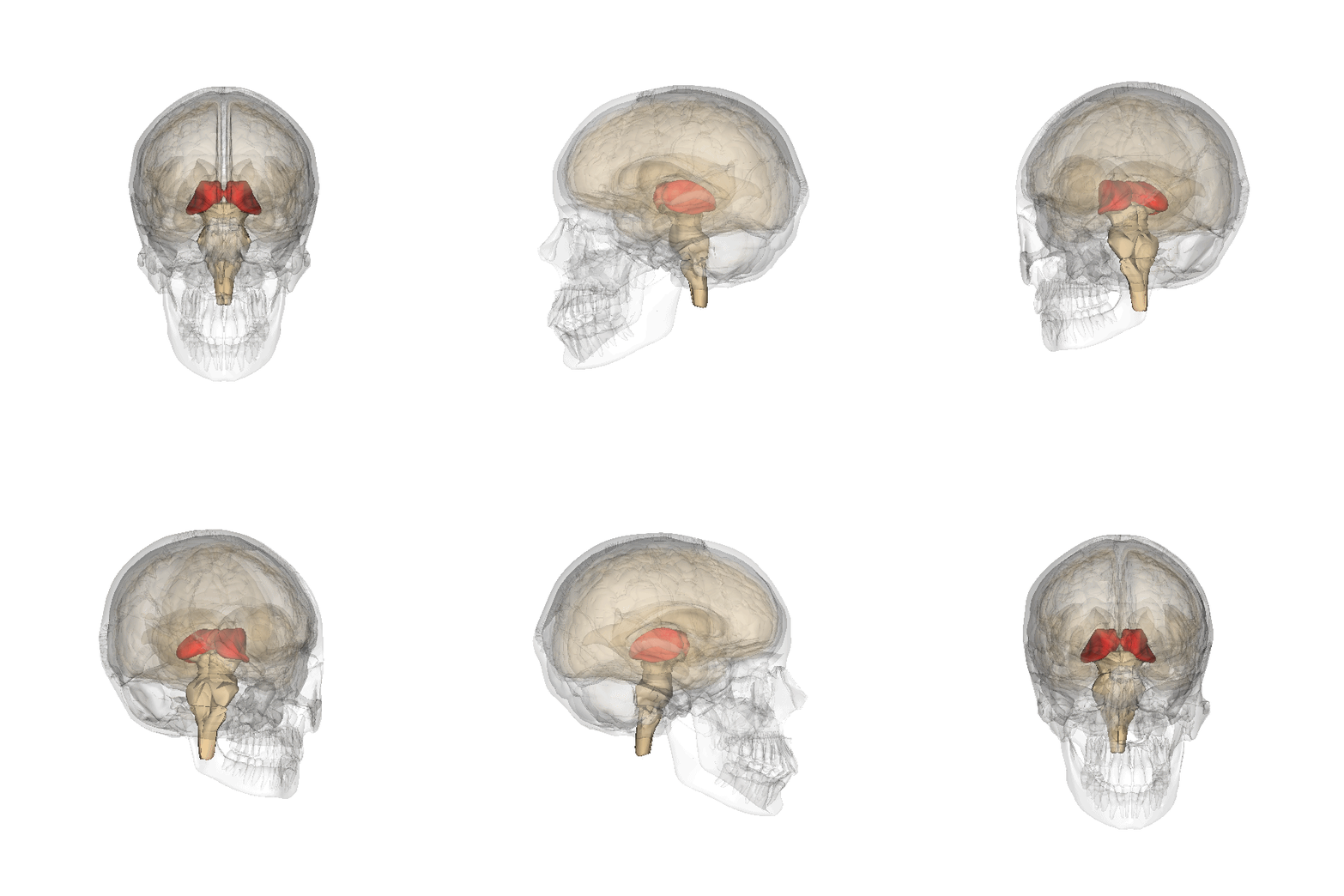
Cortex (beige) surrounding the thalamus (red) in human brain.
This GIF shows the brainstem (just below thalamus, also beige) extending through the base of the skull.
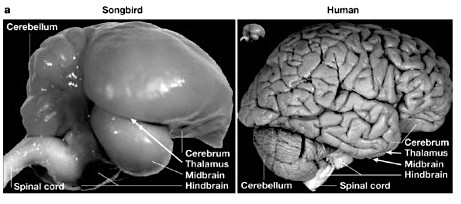
Avian brains and a new understanding of vertebrate brain evolution.
Jarvis, E., Güntürkün, O., Bruce, L. et al., 2005.
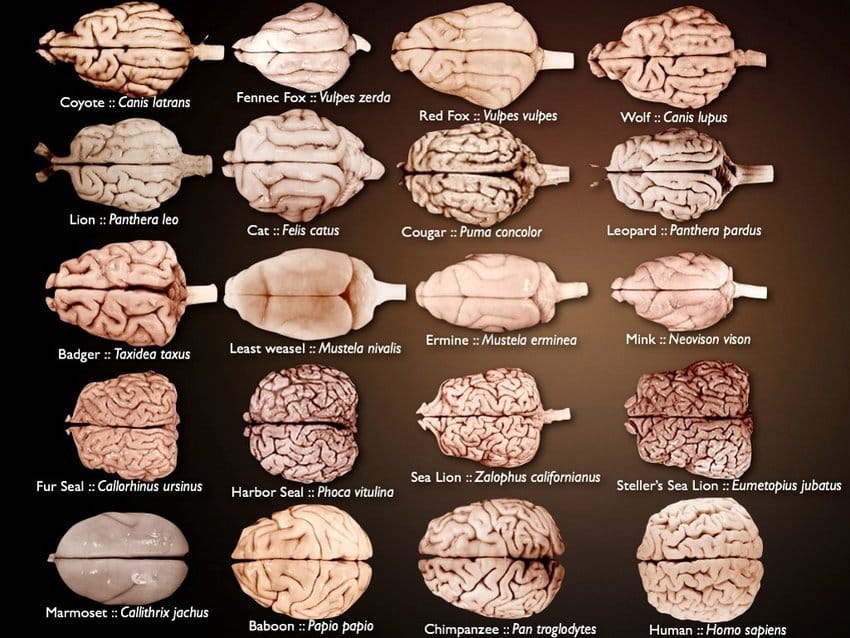
Different mammalian brains, varying in size and complexity.
The bird brain is tiny compared to the human brain. The cerebral cortex is basically a very large sheet that is only six layers of cells deep. The human brain, therefore, has to be folded many times in order to fit inside of the cranium. Notice the size difference in the second image on the right, where the songbird brain is placed to the upper left of the human brain. A typical human brain is about 750 cubic centimeters, and a typical songbird brain might be 2 or 3 cubic centimeters. Their proportion is about 100-1, thereabouts.
Image 1: Cortex (beige) surrounding the thalamus (red) in human brain. The brainstem (just below the thalamus, also beige) extends through the base of the skull into the spinal cord (not shown). Source: Life Science Databases(LSDB)
Image 2: Avian & Human Brain: Jarvis, E., Güntürkün, O., Bruce, L. et al. Avian brains and a new understanding of vertebrate brain evolution. Nat Rev Neurosci 6, 151–159 (2005). https://doi.org/10.1038/nrn1606
Image 3: Different mammalian brains, varying in size and complexity. Source: National Museum of Health and Medicine’s University of Wisconsin and Michigan State Comparative Mammalian Brain Collections
Ann Butler, Harvey Karten and others published a consensus article proposing that the word “pallium” should be dropped for birds and reptiles, and “cortex” should be used instead (Jarvis, E., Güntürkün, O., Bruce, L. et al., 2005). [Link]
In Part II, we will discuss:
- The Search for Animal Consciousness: Humans as a Benchmark
- Consciousness in Invertebrates: The Cephalopod Case
- The Case for Avian Consciousness
- Comparative Brain Anatomy
- The Visual Cortex
- How Is Consciousness Defined?
- Behaviors, Anatomy & Function as Markers for Subjectivity
- Prefrontal Cortex: Does PfC Play a Role in the Conscious Brain of Mammals?
- Higher Order Consciousness