
Glossary of Terms & Definitions
Glossary Overview
An overview of key terms on animal consciousness.
Accurate Report
Conscious sensory events are generally indexed by accurate reports. The field of perception and psychophysics has gathered this evidence over two hundred years. You can accurately report your conscious experience of the period at the end of this sentence. That behavior provides evidence of your visual experience.
Animals can also “report” their experience by matching a new stimulus with a memory of a previous one, as if to say “my new experience of this event matches my memory of my previous experience of this event.” This method is called “match-to-sample”, and it has shown us that parrots have excellent conscious color vision, for example, while dogs do not.
Binocular Rivalry
Two incompatible visual inputs will compete with each other rather than combining into a single conscious experience. One example is to present a human face to the left eye, and a house to the right eye, two inputs that cannot be fused into a single experience. Such incompatible visual images tend to push each other out of consciousness.
Explanations vs. Correlates of Consciousness
Scientists look for explanatory hypotheses, such as the notion that the visual cortex may be necessary for conscious vision. There is a causal relationship between a well functioning cortex and the ability to experience a visual event. Some philosophers argue that we can only find correlates between the brain and consciousness, but many scientists believe we already know causal mechanisms.
Homology vs. Analogy
Biologists call two similar organs in two different species ‘homologous‘ if those organs look very similar. However, brains in mice and in humans are not homologous, but they are analogous, meaning that there are many important similarities but that we cannot jump from mice to humans as if there are no important differences.
The word functional is used to define what the particular biological structure does.
Primary Consciousness
Conscious visual or auditory events are considered primary because they involve sensory organs that animals have simply by virtue of being members of their species.
Higher Order Consciousness
Higher Order Consciousness involves abstract categories that are often inferred from primary sensory experiences, but which go beyond sensory consciousness. For example, your ability to see the words on this page could be considered to be primary, but your ability to understand the meaning of this sentence is a higher order achievement.
Transitive Inference
The ability to connect two or more separate relations is widely regarded as a fundamental process in reasoning.
Such abilities have been demonstrated in certain birds. For example, in experiments involving the relative ranking of objects presented in pairs, pigeons were able to determine that B>D after they had separately learned that A>B, B>C, C>D, and D>E, while great tits have been observed to deduce complex social dominance rankings [30].
Taxa
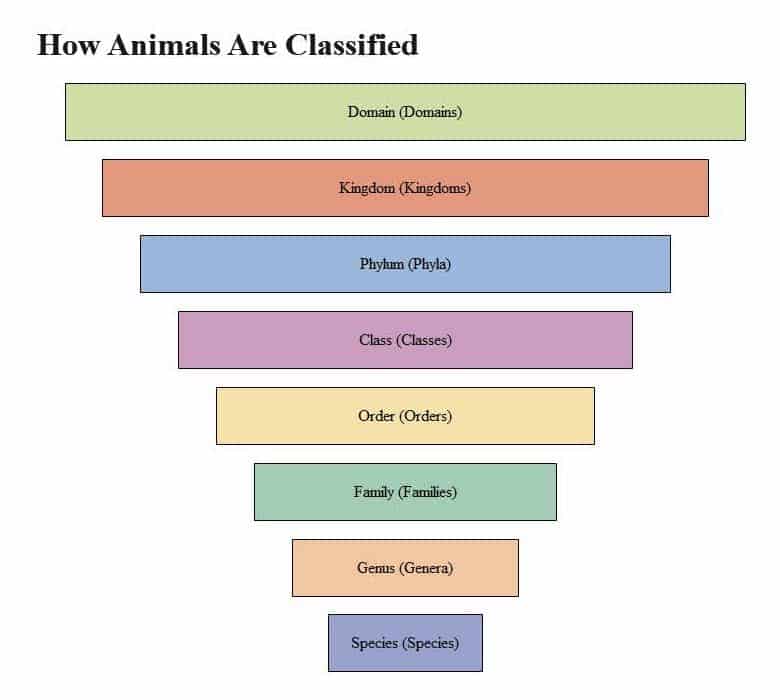
A “taxon” is a biological category, which could be a species or a variety or a phylum. For example, dogs are a species that have many varieties that look quite different from each other, and the dog species is itself a member of Mammalia.
“Taxon” is the singular of “Taxa”.
Mimicry
In biology, mimicry is the close external resemblance of an animal or plant (or part of one) to another animal, plant, or inanimate object. For example, an octopus will adapt its shape and color to match its environment, or another animal, to hide itself.